
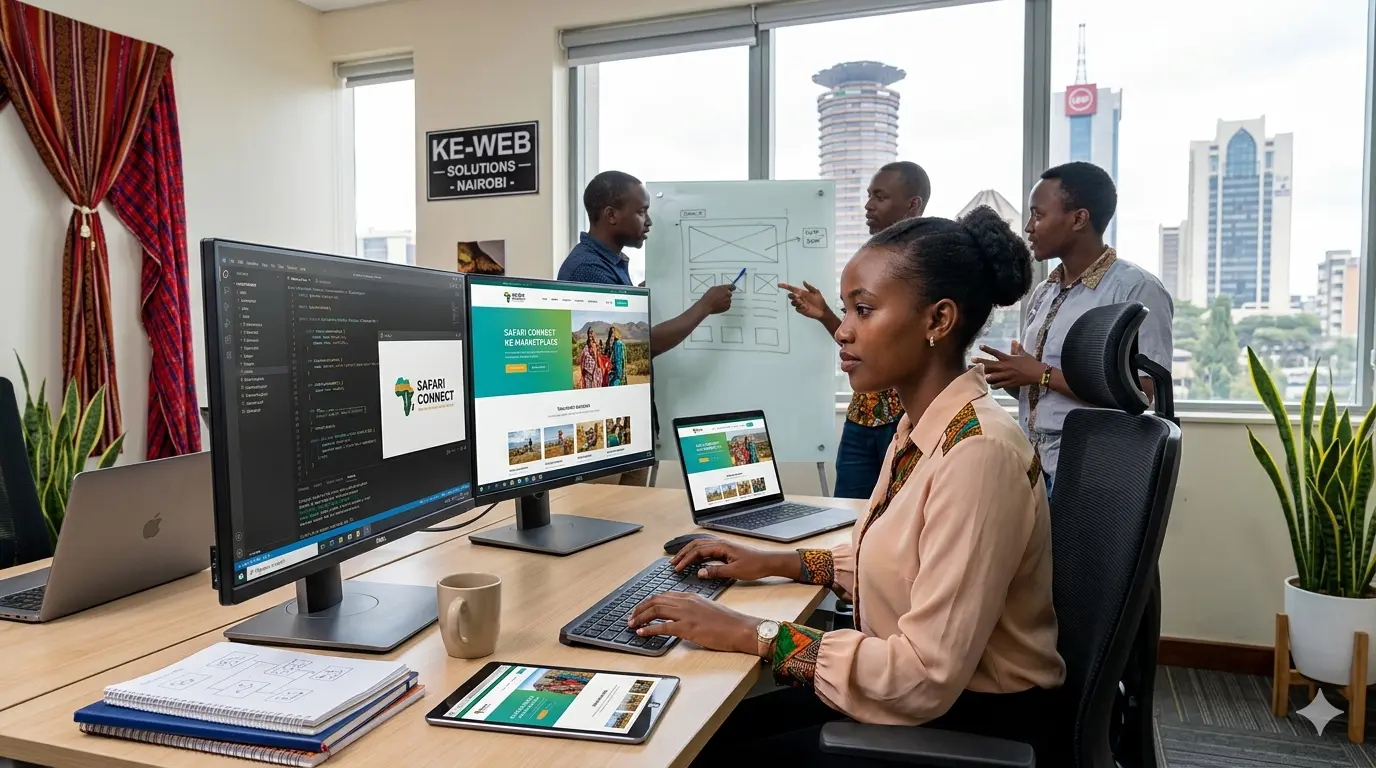
In the busy streets of Nairobi or the growing hubs of Mombasa and Kisumu, “word of mouth” has moved online. If your business isn’t easily found on a smartphone, you basically don’t exist to the modern Kenyan consumer. But in 2026, a “pretty” website isn’t enough. You need a site that answers questions.
What is the Cost of Web Design in Kenya?
This is the #1 question business owners ask. In 2026, professional web design in Kenya typically ranges from KSh 25,000 for a basic landing page to KSh 150,000+ for a full e-commerce setup with M-Pesa integration.
Pro Tip: Don’t just look at the price tag. A cheap website that doesn’t rank on Google is a liability, not an asset.
3 Reasons Your Current Website Isn’t Ranking in Nairobi
If you already have a site but you’re not getting leads, it’s likely due to one of these three local SEO killers:
- Poor Mobile Optimization: Over 85% of Kenyans access the internet via mobile. If your site is slow on Safaricom or Airtel data networks, Google will push you to page 10.
- Lack of Local Intent: You need to mention specific areas you serve (e.g., “SEO Services in Westlands” or “Web Design in Kilimani”) so Google knows exactly where to show your business.
- No “Answer Engine” Strategy: AI search engines now look for direct answers. If your site doesn’t have an FAQ section, you’re missing out on the “Zero-Click” searches.
Our Expert Google SEO & Web Design Services
At FUYA DIGITAL, we don’t just build sites; we build “Answer Machines.” We focus on AEO (Answer Engine Optimization) to ensure you show up when someone asks their phone, “Who is the best digital marketer in Nairobi?”
Our Core Services:
- High-Speed Web Development: Optimized for 5G and low-bandwidth areas alike.
- M-Pesa & Lipa na M-Pesa Integration: Essential for any Kenyan e-commerce store.
- Topical Authority Blogging: We write the FAQs that your customers are actually searching for.
- Google Business Profile Setup: Ensuring you show up on Google Maps for local “near me” searches.
A standard professional website takes between 2 to 4 weeks, depending on the complexity and how quickly the content is provided.
Yes. We specialize in API integrations that allow your customers to pay directly via M-Pesa, with automated receipts and order tracking.
Absolutely. In 2026, Google rewards “Helpful Content.” By regularly posting answers to customer problems, you build authority that forces Google to rank you above competitors who only have static pages.
How to Launch Your Digital Presence in Kenya (Step-by-Step)
- Secure a .KE Domain
While
.comis global, a .co.ke or .ke domain tells Google’s local algorithm that your business is physically in Kenya. This gives you an immediate ranking boost for “near me” searches in cities like Nairobi, Mombasa, or Eldoret.
Time needed: 15 minutes.
Cost: Approx. KSh 600 – KSh 2,500 per year. - Build an “Answer-First” Website
Avoid heavy, slow-loading graphics. Use a “Mobile-First” design. Ensure your homepage immediately answers: What do you do? Where are you located? How can I pay via M-Pesa?
Critical Tip: Ensure your site loads in under 3 seconds on a standard Safaricom 4G connection. - Set Up Your Google Business Profile
Register your business on Google Maps. This is the “Holy Grail” of local SEO. Upload photos of your office or work, and ask your Kenyan clients for reviews.
Pro Tip: Use a local Kenyan phone number (+254) to verify your location. - Create Your “Topical Cluster” Blog
Don’t just blog about anything. Identify 5 core problems your customers have and write a 1,000-word “How-To” guide for each.
Example: “How to register a business in Kenya” or “How to clear goods at KPA Mombasa.” This builds Topical Authority. - Integrate Local Payment Gateways
Don’t make your customers wait for an invoice. Integrate Lipa na M-Pesa or gateways like Pesapal directly into your site. In 2026, convenience is the biggest ranking factor for “User Experience” (UX).